
Being a promotional products enterprise in 2026 is a terrific decision, indeed! The market for promotional items continues to be very big and will further develop. According to the Promotional Products Association International (PPAI), the sector is over $25 billion in worth in the U.S. at the moment. This signifies that there are real odds for fresh entrepreneurs.

The insightful path that we present in this manual contains the full steps to be successful in your enterprise. You will have the discussion about everything from the business plan to the acquisition of your first customer. You will understand how to select an appropriate business model. You will learn how to find efficient suppliers and promote your new company.
Key Takeaways
- The promotional products industry is a large market with big profit potential.
- You can start as a low-cost distributor or buy equipment as an in-house decorator.
- A solid business plan and a specific niche are key for standing out.
- Building a strong network of suppliers is the foundation of a successful promotional products company.
- Finding your first clients means using your local network and forming smart partnerships.
Understanding the Business Model
How does a promotional products company make money? The main idea is simple. You act as a middleman or distributor.
You find businesses that need branded items like pens, t-shirts, or tote bags. You then get these products from wholesale suppliers. Next, you arrange for someone to print or embroider the company’s logo on the items.
Finally, you sell the finished products to the client at a higher price. Your profit comes from the difference between your costs and your selling price. You can also earn money from setup fees, design charges, and shipping fees.
For example: You buy 100 mugs for $3 each ($300 total). You pay a printer $2 per mug for the logo ($200 total). Your total cost is $500. You sell the mugs to your client for $8 each ($800 total). This leaves you with a $300 gross profit.
Choosing Your Path: Distributor vs. Decorator
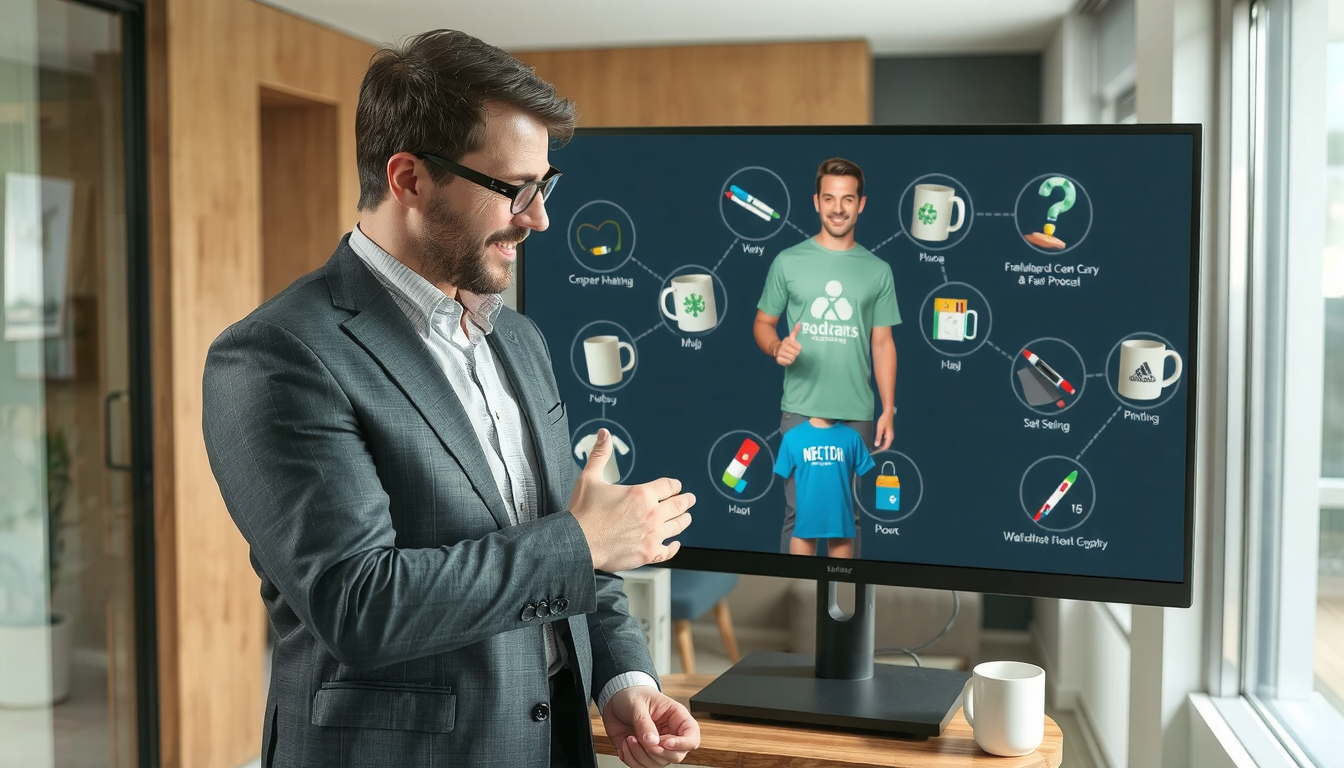
Before you start, you must make a key choice. Will you be a distributor or an in-house decorator? This choice affects your startup costs and how your business runs. Most new owners of a promotional products company face this choice.
The Distributor Model (Asset-Light)
This is the most common way to start. You are the sales and project manager. You connect clients with products and services. You do not own any printing or embroidery machines. Instead, you outsource all production to trusted partners.
- Pros: Low startup costs, huge product variety, and great flexibility.
- Cons: Lower profit margins, dependence on partners, and less control over quality.
The In-House Decorator Model (Vertical Integration)
This model means you buy your own equipment. You might get a screen printer, an embroidery machine, or a laser engraver. You produce the customized goods yourself.
- Pros: Higher profit margins, complete quality control, and the potential for faster turnarounds.
- Cons: High initial cost for equipment, need for special skills, and you are limited by your machines.
| Feature | Distributor Model | In-House Decorator Model |
|---|---|---|
| Startup Costs | Low (under $2,000) | High ($10,000+) |
| Profit Margins | Lower (30-40%) | Higher (40-60%+) |
| Scalability | Easy to scale sales | Harder to scale production |
| Required Skills | Sales, project management | Technical skills, machine operation |
| Product Range | Nearly unlimited | Limited to your equipment |
Your 7-Step Launch Plan
Ready to build your company? Follow these seven steps to go from idea to a launch-ready business. This plan is your roadmap to starting a successful promotional products company.
Step 1: Write Your Plan and Find Your Niche
A business plan is your guide. It helps you think through your strategy and can help you get funding. The U.S. Small Business Administration has great resources to help you write your business plan. Your plan should include a market analysis and financial goals.
Don’t try to sell everything to everyone. Choose a niche to stand out. You could focus on eco-friendly products, tech startups, local breweries, or schools. A niche makes your marketing easier and more effective.
Step 2: Handle Legal and Financial Setup
Getting your business structure right from the start is important. It protects you legally and makes taxes simpler. Every new promotional products company needs to complete these tasks.
- Checklist for Setup:
- Choose a unique business name and register it.
- Decide on a legal structure. Sole Proprietorship or LLC are common for beginners.
- Apply for an Employer Identification Number (EIN) from the IRS. It’s free.
- Open a separate business bank account to keep finances clean.
- Look into local permits and get a reseller’s certificate. This lets you buy goods tax-free for resale.

Step 3: Build Your Supplier Network
Your suppliers are your most important partners. They provide the products you sell. Finding reliable suppliers is key to your success.
Industry groups like the Advertising Specialty Institute (ASI) and PPAI are the best places to start. Membership gives you access to a huge database of vetted, trade-only suppliers.
When choosing partners, always do your homework. Ask for product samples, check online reviews, and understand their production times. Clear communication with your suppliers will prevent many problems.
Step 4: Develop Your Pricing Strategy
Pricing can feel tricky, but there are industry standards. Many suppliers use a coded system that gives you better pricing as you order more. “End Quantity Pricing” (EQP) is a common goal. With EQP, you get the best price regardless of quantity.
To set your price, use this formula: (Product Cost + Decoration Cost + Shipping) / (1 – Your Desired Margin %). For example, if your all-in cost for an item is $5 and you want a 40% margin, you would sell it for $8.33 ($5 / 0.60).
Remember to account for other charges. These can include one-time setup fees for artwork or rush fees for tight deadlines.
Step 5: Set Up Your Tech Stack
A modern promotional products company needs the right digital tools to run smoothly. You don’t need to spend a lot of money to get started.
- Essential Tools:
- CRM (Customer Relationship Management): Use a tool like HubSpot Free or Zoho to track your leads and clients.
- Design Software: Canva is great for creating simple product mockups. Adobe Illustrator is the professional standard.
- Accounting Software: QuickBooks or Wave will help you manage invoices and track expenses.
- Website/E-commerce: A platform like Shopify or WordPress is essential to show your products.
Step 6: Create Your Brand and Online Presence
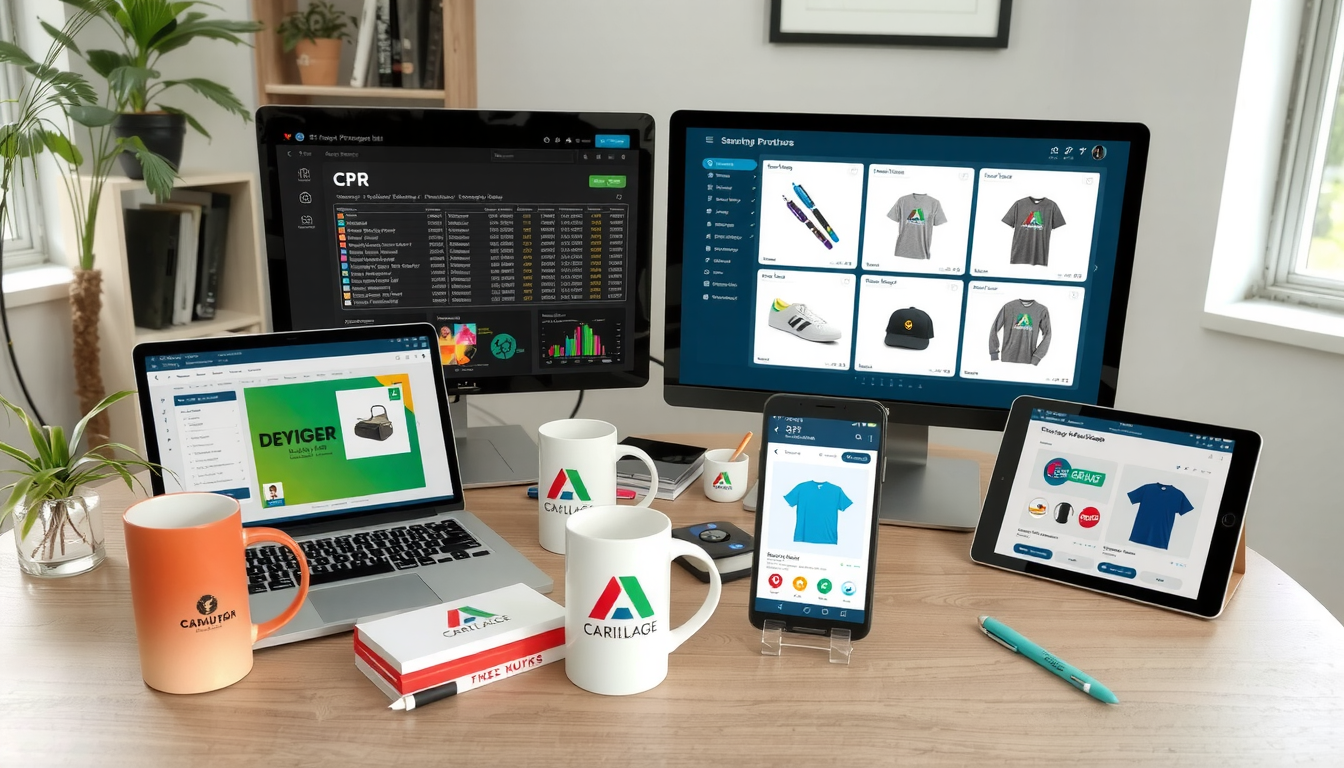
Your brand is more than just a logo. It is how customers see your company. Your brand identity should reflect the niche you chose. If you focus on eco-friendly products, your branding should look natural and green.
A professional website is a must. It is your digital storefront. Your site needs an “About Us” page, a portfolio of your work, and clear contact information. Even if you have no clients yet, you can create mockups of products for your portfolio.
Many new companies also benefit from white-label websites offered by industry suppliers. These sites come pre-loaded with products. You can then sell under your own brand. This can be a fast way to get online.
Step 7: Landing Your First 5 Clients
Getting your first clients is the most exciting milestone. Don’t wait for them to find you. Here are proven strategies to get your first sales.
- Use Your Local Network: Start with people you know. Talk to local businesses you visit, like your coffee shop or gym. Offer them a special introductory package to get your foot in the door.
- Partner with Other Businesses: Connect with graphic designers, marketing agencies, or event planners. They often have clients who need branded merchandise but don’t offer it themselves. You can refer business to each other.
- Focus on One Social Media Channel: Don’t spread yourself too thin. Pick one platform where your ideal clients spend their time. For B2B, LinkedIn is powerful. Share helpful content and case studies of your work.
- Join a Local Business Group: Groups like a local Chamber of Commerce or a BNI chapter are designed for networking. They are a great way to meet other business owners and build relationships.
Keeping the Momentum: Marketing Your Company
Once you have a few clients, it’s time to build on that success. Ongoing marketing is what turns a new venture into a stable promotional products company.
Start by building a strong portfolio. Ask your happy clients for testimonials and reviews. A good review can be incredibly powerful for convincing new customers.
Create simple case studies for your website. Use a “Problem -> Solution -> Result” format. For example: “Problem: A local brewery needed giveaways for a festival. Solution: We provided 500 custom-branded bottle openers. Result: They were a huge hit and increased brand visibility.”
Finally, stay on top of trends. Browse blogs with fresh marketing and promotional ideas to find inspiration for your clients. Offering new and exciting products will make you a more valuable partner.
FAQ: Starting a Promotional Products Company
Here are answers to some common questions about starting in this industry.
How much does it cost to start a promotional products company?
The cost varies greatly. A distributor model can be started for under $2,000. This covers business registration, a basic website, and industry association fees. An in-house decorator model can cost $10,000 or more because of expensive equipment.
Is the promotional products business profitable?
Yes, it can be very profitable. Gross profit margins for a promotional products company typically range from 30% to 50% or more. Your final profit depends on your client base, how well you manage costs, and your operational efficiency.
Do I need to be a graphic designer?
No, it’s not required, but basic design skills are helpful for creating mockups. Most suppliers have art departments that can fix logos for a small fee. You can also partner with a freelance designer for more complex client requests.
Where do promotional product companies get their products?
They source products from a large network of wholesale, “trade-only” suppliers. These suppliers do not sell to the public. The main way to access this network is by joining an industry organization like PPAI or ASI.
What is the biggest challenge for a new promotional products company?
The biggest initial challenge is standing out. The market has many players, so differentiation is key. You can stand out by focusing on a specific niche, providing exceptional customer service, or offering unique and creative ideas. This is crucial for attracting and keeping your first clients.
Conclusion
You now have the blueprint to launch your own promotional products company in 2026. We have walked through understanding the business model, creating a plan, and winning your first clients.
Success in this field comes from building strong relationships and providing real value. You are not just selling products. You are helping other businesses grow their brand. For a well-prepared entrepreneur, a great opportunity awaits.
